Weekly Token Unlocks Digest: Feb 23-Mar 1, 2026 | The Shift Toward Deflationary Tokenomics



Crypto markets remain in consolidation mode, but supply dynamics continue to drive price action beneath the surface. In this report, we break down last week’s supply-driven underperformance, highlight major upcoming unlocks including $SUI and $GRASS, and examine notable tokenomics shifts from $HYPE and $APT — both signaling a broader industry pivot toward supply discipline and deflationary mechanics.
🔑 Key Takeaways
- Supply pressure remains a dominant theme: Tokens with heavy emissions over the past 30 days have broadly underperformed, reinforcing the dilution-overhang narrative in 2026.
- $SUI faces the largest dollar unlock next week: With price already down ~80% from its 2025 peak, continued emissions may limit upside without renewed demand.
- $GRASS cliff unlock is structurally significant: ~10% of circulating supply will vest to insiders, marking the first major release from a 2-year schedule.
- $HYPE allocates 1M tokens toward policy engagement, expanding strategic utility.
- $APT proposes a hard cap, reduced staking rewards, fee burns, and KPI-based emissions — a clear shift from inflationary bootstrap to revenue-aligned tokenomics.
Weekly Unlocks Recap
The past week in crypto saw a consolidating market with modest downside pressure amid lingering macro caution, deleveraging after earlier sharp drawdowns, and selective pockets of resilience in altcoins. The broader crypto sector continued its recovery efforts from February's early volatility, but lacked strong catalysts for a decisive breakout. Markets digested ongoing Fed uncertainty and awaited key upcoming data like PPI number.
A snapshot of recent supply-side pressure underscores why many mid/small-caps struggled: significant token emissions and unlocks over the past 30 days often correlated with sharp price declines.
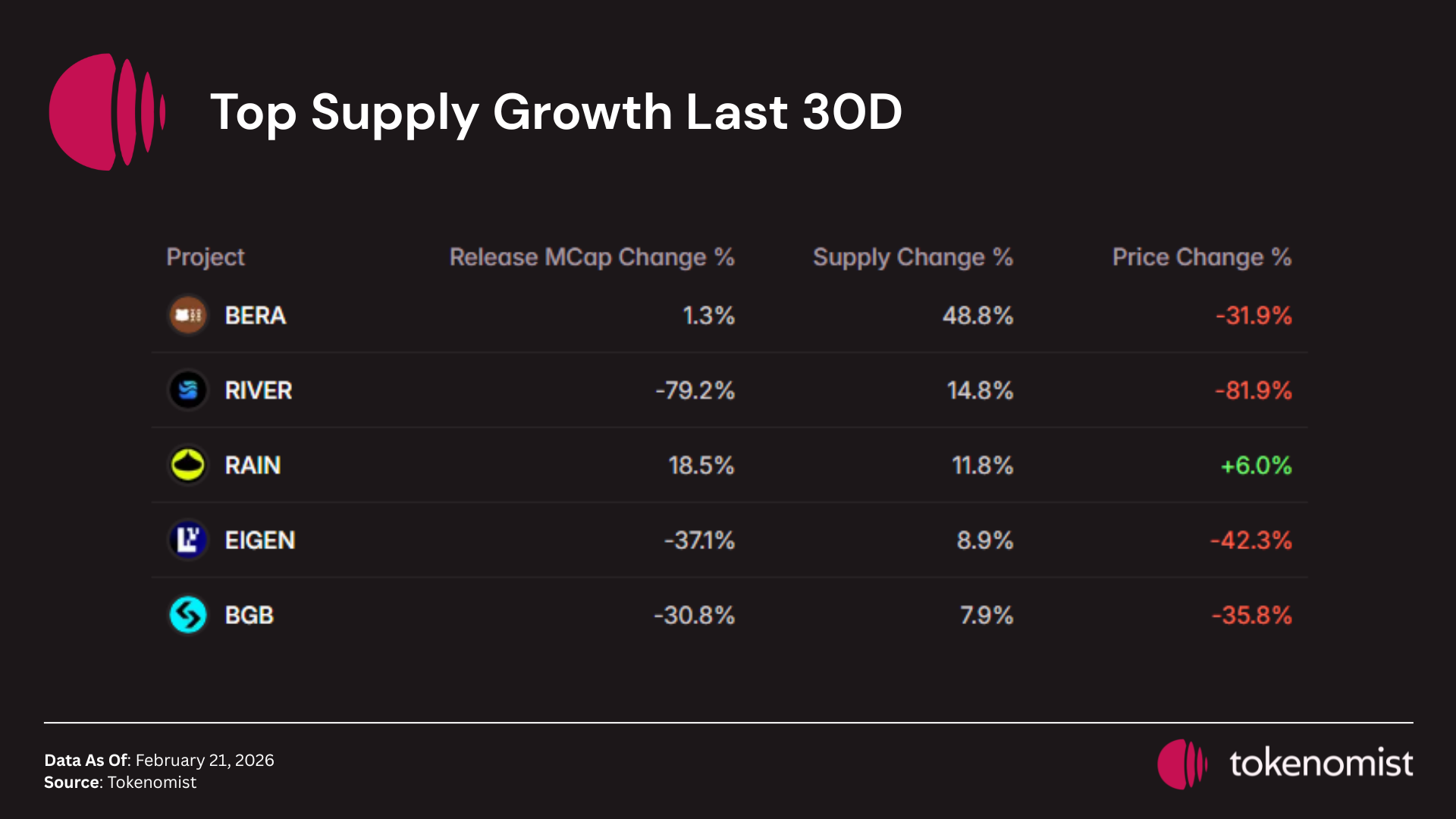
These cases illustrate how rapid circulating supply expansion—typically from vesting unlocks or scheduled releases—can create persistent selling overhang without corresponding demand growth. This supply pressure theme aligns with broader 2026 trends, where maturing projects increasingly pivot toward deflationary mechanics to counter such dilution risks.
Upcoming Events
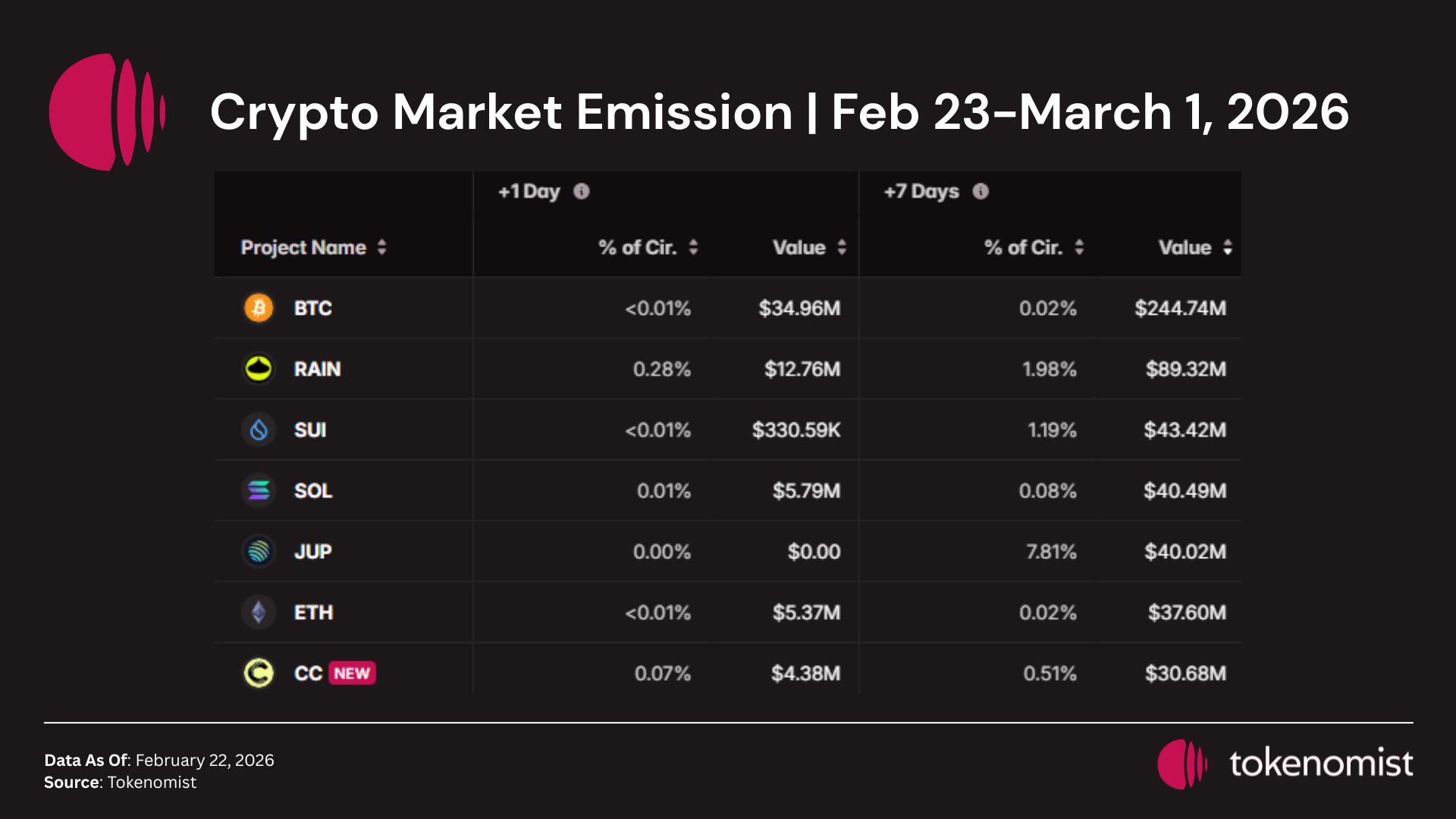
Next week’s scheduled token releases are set to exceed $770 Million in total value. Notable tokens facing sizable releases include $BTC, $RAIN, $SUI, $SOL, and $JUP.
Unlocks Spotlight: $SUI
- Unlock Date: March 1, 2026
- Amount: $41M
- Unlock as % of Circulating Supply: 1.13%
- Vested Allocations: Series B, Community Reserve, Early Contributors, and Mysten Labs Treasury
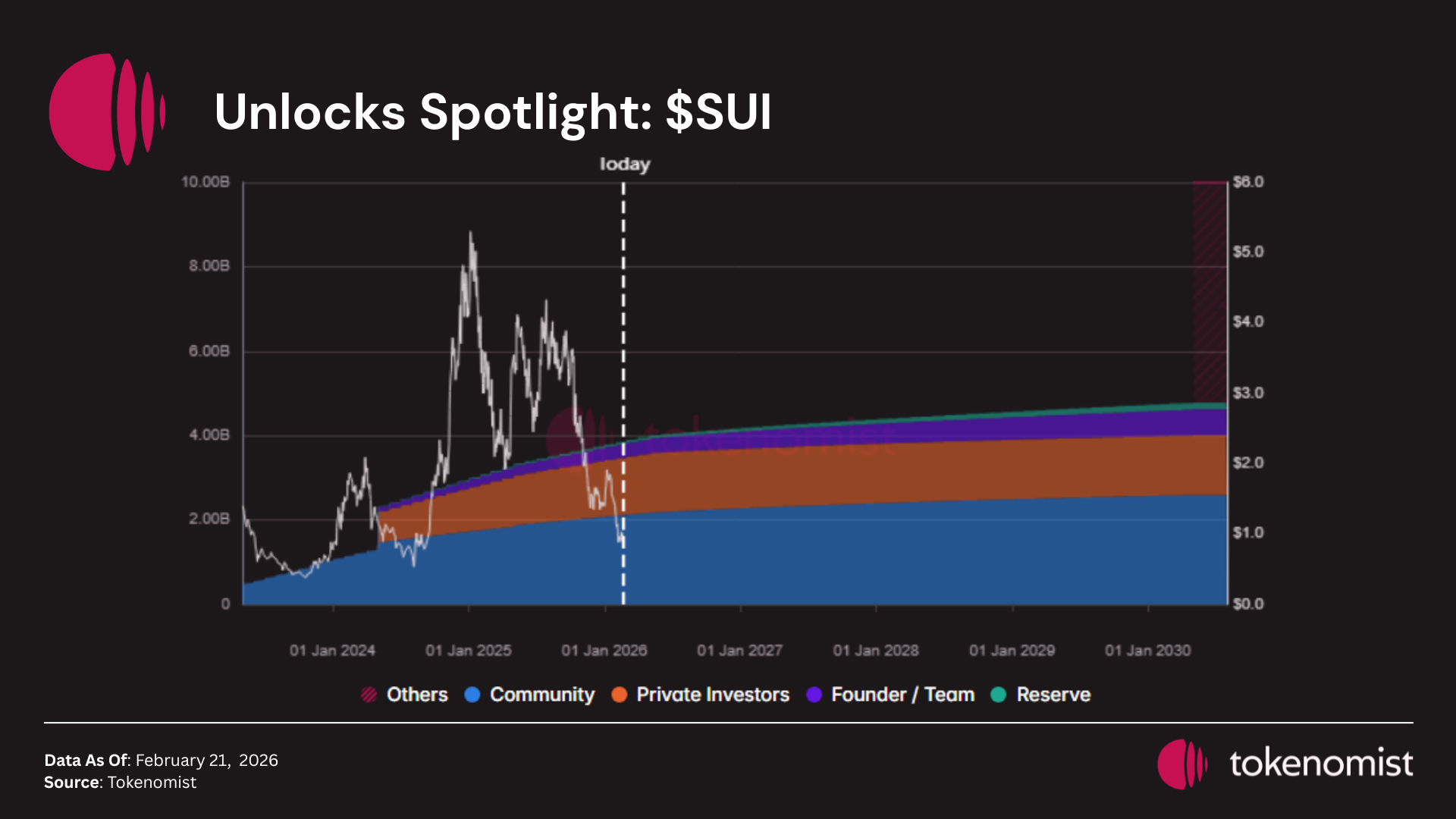
$SUI is set to record the largest unlock by dollar value in the coming week, with allocations distributed to both investors and community cohorts. Price action has already been under sustained pressure, with $SUI down more than 80% from its early-2025 peak, mirroring the broader deterioration in market sentiment. In this context, continued scheduled emissions could act as an additional overhang, particularly if liquidity remains thin and risk appetite subdued.
Unlocks Spotlight: $GRASS
- Unlock Date: February 28, 2026
- Amount: $10.5M
- Unlock as % of Circulating Supply: 13.15%
- Vested Allocations: Contributors
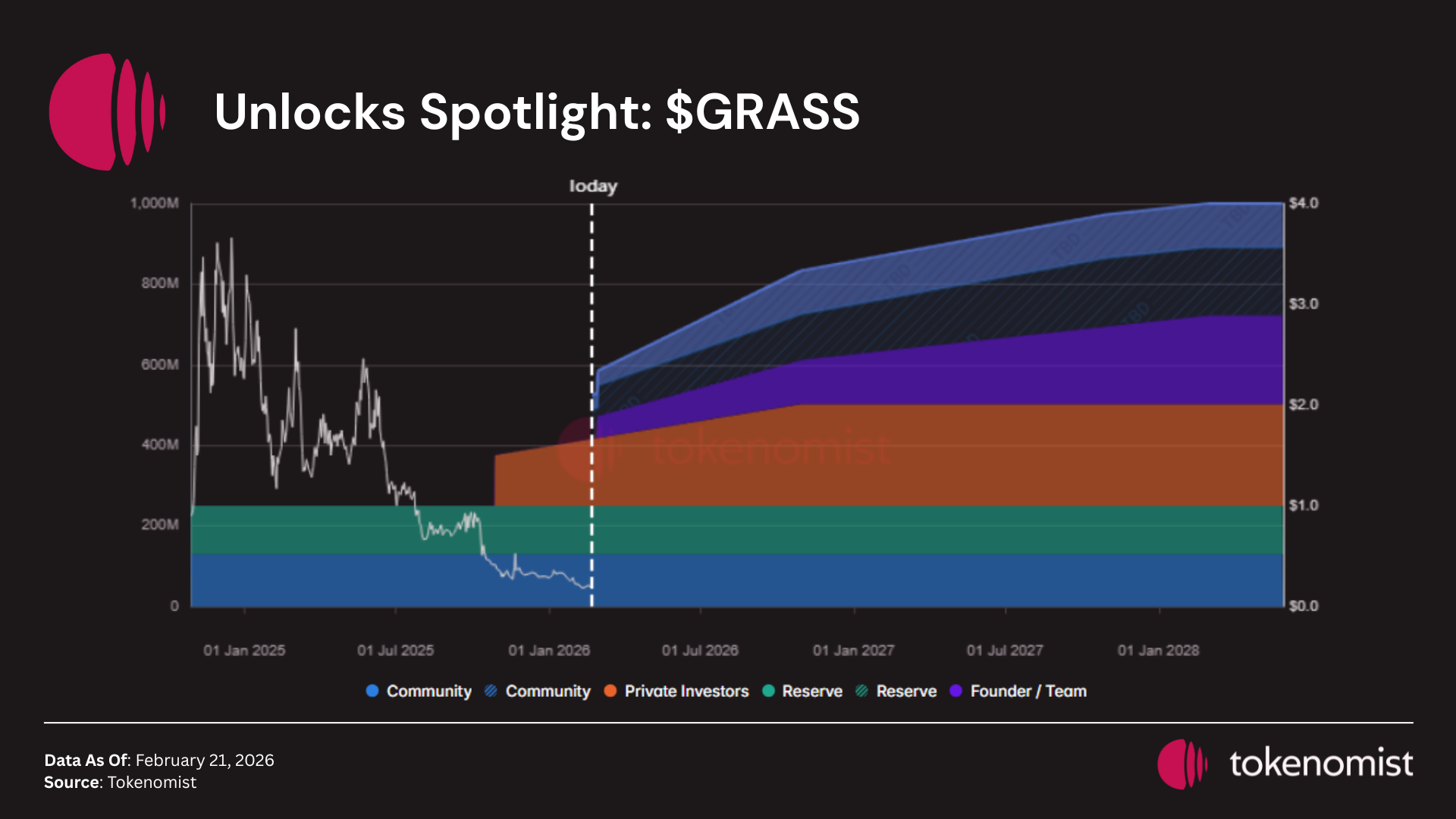
$GRASS stands out as a potential volatility trigger this week, recording one of the largest unlocks relative to circulating supply (~10%). Notably, 100% of the vested tokens are allocated to insiders, marking the first cliff unlock from a two-year vesting schedule for founders and the core team.
Cliff events tend to carry greater market impact than linear emissions, as they introduce a step-change in available supply. With $GRASS already trading in a persistent downtrend since TGE, this unlock adds another layer of structural pressure. In the absence of a meaningful catalyst to offset new supply, near-term price action may remain vulnerable.
Notable Tokenomics Update
$HYPE Allocates 1M Tokens to Policy Initiative
The Hyperliquid Foundation has announced the allocation of 1 million $HYPE to establish the Hyperliquid Policy Center, an initiative aimed at supporting DeFi advocacy and regulatory engagement in Washington, D.C.
While the allocation represents a relatively small portion of total supply, the strategic implication is notable. Rather than directing tokens solely toward ecosystem incentives or liquidity programs, the foundation is deploying capital toward long-term regulatory positioning. This signals a proactive approach to policy engagement at a time when DeFi scrutiny remains elevated.
The Hyper Foundation will contribute 1M HYPE tokens to support the creation of the Hyperliquid Policy Center.
— Hyperliquid (@HyperliquidX) February 18, 2026
The tokens will be unstaked later today. The Hyperliquid community will benefit from having representation in Washington, D.C., and we are confident that under… https://t.co/Vgo95Nrr17
Aptos Tokenomics Overhaul
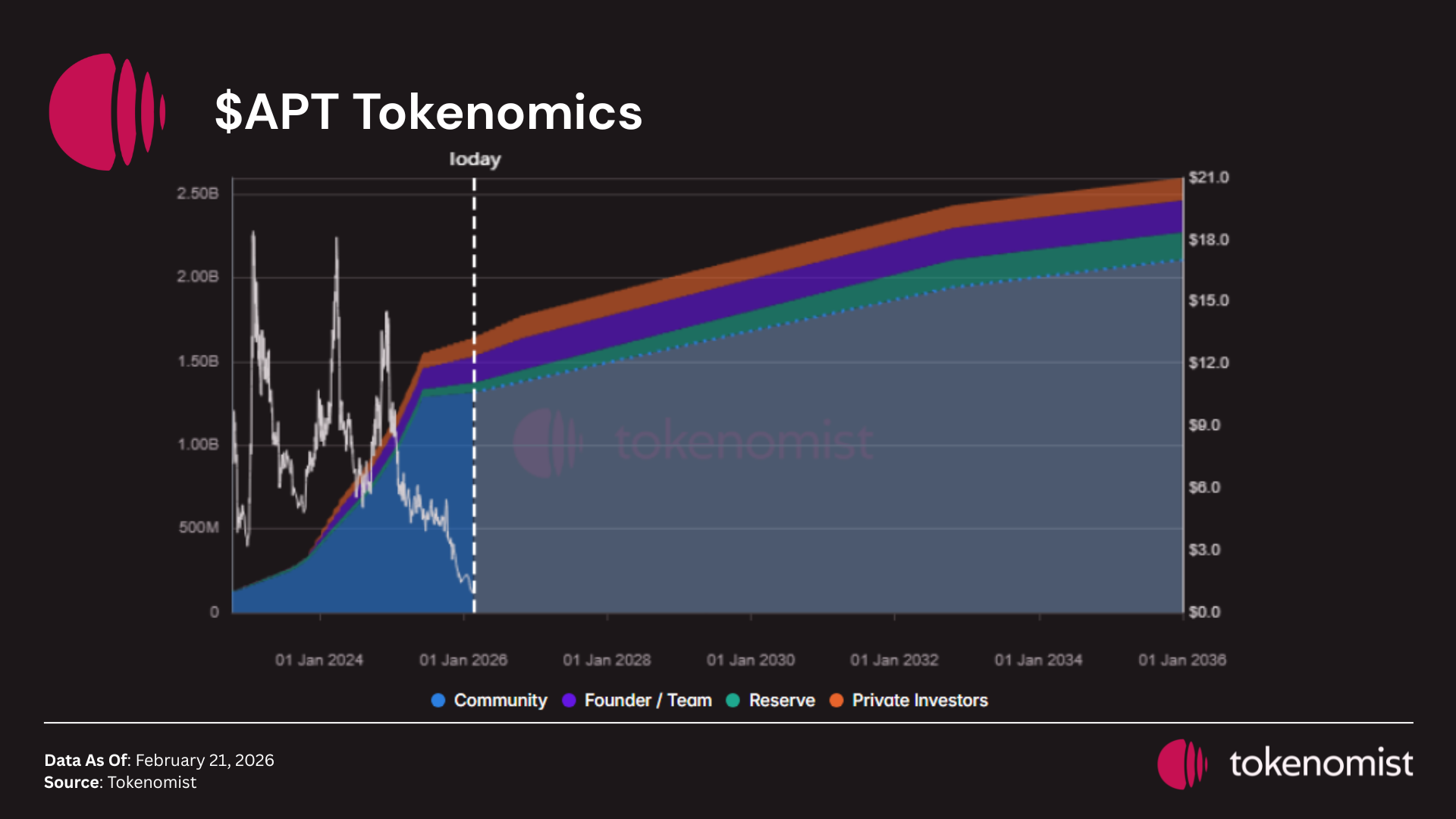
Aptos unveiled a significant tokenomics overhaul, signaling a decisive shift from its early-stage inflationary “bootstrap” model to a performance-driven, deflationary framework. Key proposed changes include:
- A hard supply cap of 2.1 billion $APT tokens (with roughly 1.196 billion currently in circulation).
- Staking rewards reduced by half, from 5.19% to 2.6% annually.
- Investor unlocks concluding in 2026, resulting in an estimated 60% YoY reduction in new emissions post-October.
- Gas fees increased 10× network-wide and 100% of base fees will now be burned in $APT.
- The Foundation permanently locking and staking 210 million $APT.
- Ecosystem grants and future emissions strictly linked to achieved KPIs and milestones.
The centerpiece of the deflationary design is the expectation that token burns will eventually outpace new emissions, especially as applications like the high-TPS Decibel DEX drive sustained transaction volume. This marks a clear pivot toward revenue-aligned economics over perpetual inflation.
— Aptos (@Aptos) February 18, 2026
As of mid-February 2026, Aptos operates under an uncapped, inflationary model with no hard maximum supply. Circulating supply stands at approximately 779 million APT, driven by ongoing staking rewards (currently ~5.19% annualized) and scheduled unlocks from early allocations. Without intervention, emissions would persist indefinitely, creating persistent dilution risk.